Debt Collection in Vietnam
Find out which personal and corporate debts can be recovered in Vietnam, the procedures available and how our lawyers in Vietnam can help you collect a debt.
If you need support for debt collection in Vietnam, our lawyers are at your service. Discover the available procedures and how our lawyers can help you below.
What are the types of debts that can be chased in Vietnam?
- Personal: bank loans, credit card financing, mortgages, etc.;
- Corporate: various types of loans that can be contracted by Vietnamese companies, invoices, etc.
What are the available types of debt recovery procedures in Vietnam?
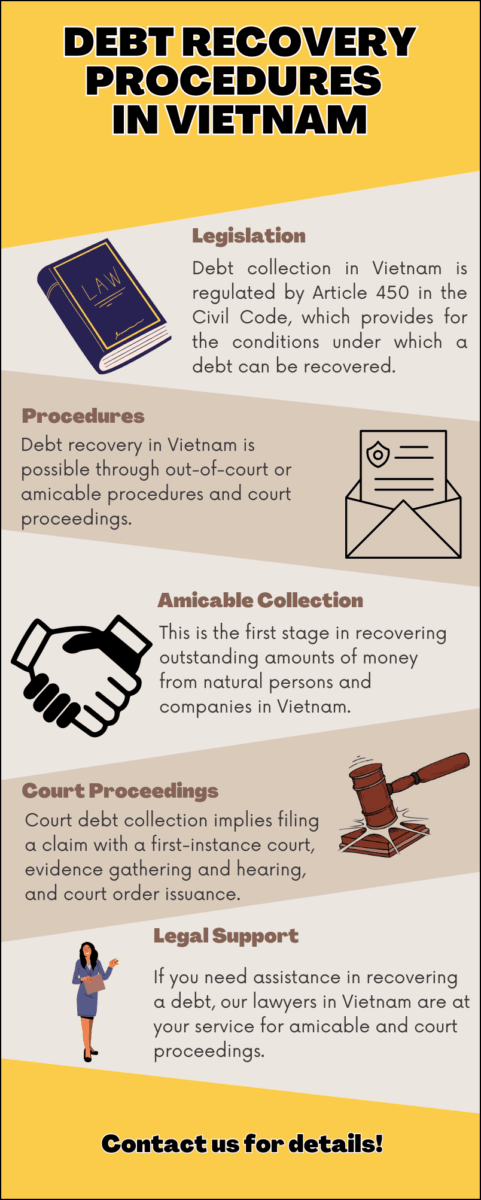
- amicable procedure, which can be carried out with or without representation from a Vietnamese lawyer;
- court proceedings, where representation by a lawyer is recommended but not mandatory.
What are the main debt collection steps in Vietnam?
- contact the debtor to notify him/her/it about the debt;
- try to reach a mutual agreement and new payment terms (if this step is successful, the process stops here);
- court proceedings if the debtor does not reply or agree to the amicable procedure.
Here is also an infographic on debt recovery procedures in this country:
Can I start a debt recovery procedure on my own in Vietnam?
Yes, you can let the debtor know about the fact that he/ she/ it has outstanding payments. However, when it comes to the procedure itself, you are not required by law to use a lawyer, although professional assistance is recommended.
IMPORTANT! Our lawyers in Vietnam advise keeping all notifications you sent to the debtor before asking for professional support.
Who can offer professional debt recovery services in Vietnam?
Law firms and lawyers only. Our Vietnamese lawyers have the necessary experience to handle debt collection procedures in an amicable manner for swift resolution.
What does amicable debt recovery imply in Vietnam?
The following stages are part of the amicable procedure for recovering the debts in this country, with complete legal assistance offered by our team of attorneys in Vietnam:
- the debtors are notified via official letters or email that they have late payments or debts;
- our debt collection lawyers will develop solid communication with the debtors involved in the case and will initiate a negotiation;
- the existing contract can be modified with additional documents consisting of new payment terms;
- if both parties agree on the new payment conditions, then the new contract is signed.
How do you handle a debt collection case in Vietnam?
We will:
- verify all the information you provide us and draft the necessary notifications and send them to the debtor;
- wait for a reasonable time for a response from the debtor and try to reach a settlement that favors both parties;
- draft a new contract if the debtor agrees to the payment;
- file a petition with a civil court in case the debtor fails to meet the terms of the new agreement.
What does court debt collection imply in Vietnam?
In most cases, court proceedings in debt collection in Vietnam are started after trying to amicably recover outstanding payments. The procedure begins with filing a petition with the competent Regional People's Court, which since 1 July 2025 hears most first-instance civil and commercial cases.
The attorney will file the petition alongside various documents that prove the case. Among these are: the correspondence with the debtor related to the attempt of resolving the case amicably, proof of the amount of money due, any dunning letter (if sent), as well as other evidence that can be used to resolve the case.
In most cases, in court proceedings, the creditor will obtain the desired result with the mention that he or she can also request any interest to be paid alongside the debt.
We invite you to contact our law firm for extra details about how debt collection is made in Vietnam. Our lawyers can also help you open a company in Vietnam.
Nguyen Thi Hoa, Lawyer · 2 October 2026Nguyen Thi Hoa is a qualified lawyer and Managing Partner of CDLAF.